Civil War gun replicas are modern reproductions of firearms used in the American Civil War (1861-1865). For collectors, these reproductions can provide a practical way to study historical firearm designs, manufacturing, military technology, and the differences between Union, Confederate, and imported arms.
A Civil War gun replica is a modern reproduction designed to represent a firearm associated with the 1861 to 1865 conflict. People commonly use non-firing replicas for collecting, historical displays, education, reenactment, theater, and historical interpretation.
Frequently reproduced designs include the 1851 Colt Navy, 1860 Colt Army, M1861 Springfield, British Pattern 1853 Enfield, Richmond rifle musket, and Griswold & Gunnison revolver.
Replicas can give collectors an accessible way to study the appearance and design of historical firearms without acquiring an original 19th-century artifact.
Accuracy depends on how closely the reproduction represents a specific historical model, including its proportions, materials, markings, construction details, and period characteristics.
First, identify the exact historical model. Then compare its documented characteristics with museum collections, National Park Service resources, and other authoritative historical references.
A Civil War gun replica is a modern reproduction representing a firearm associated with the American Civil War.
The term covers a surprisingly broad range of designs. A reproduction of an 1851 Colt Navy represents a percussion revolver, while an M1861 Springfield represents a military rifle musket. A Griswold & Gunnison represents a Confederate copy of an established Colt design.
That distinction is important because a historically accurate replica should represent a specific firearm, not a generic idea of what a Civil War gun looked like.
A useful starting question is:
What exact historical firearm is this replica supposed to represent?
Once the model is identified, collectors can research its manufacturer, production period, historical users, materials, markings, and place in Civil War technology.
The National Park Service identifies the M1861 Springfield as the most popular infantry shoulder arm of the war and the 1851 Colt Navy as probably the most-used handgun.
The Civil War involved a wide mixture of firearms rather than one universal weapon. Union and Confederate forces used government-issued arms, imported firearms, older weapons, captured equipment, privately purchased arms, and newly manufactured designs.
Some of the most historically important examples include:
Firearm | Type | Historical importance |
|---|---|---|
M1861 Springfield | Rifle musket | The most popular infantry shoulder arm of the war |
Pattern 1853 Enfield | Rifle musket | Major imported arm, especially important to Confederate forces |
1851 Colt Navy | Revolver | Probably the most-used handgun of the conflict |
1860 Colt Army | Revolver | Major .44 caliber military revolver |
Griswold & Gunnison | Revolver | Confederate copy of the Colt 1851 Navy |
Richmond rifle musket | Rifle musket | Confederate production based on Federal patterns |
1841 Mississippi Rifle | Rifle | Earlier military rifle that remained in service |
Henry Rifle | Repeating rifle | Early repeating design demonstrating emerging firearm technology |
The National Park Service records the M1861 Springfield as a .58 caliber, muzzle-loading, single-shot percussion rifle musket with a 40-inch rifled barrel. It also identifies the British Pattern 1853 Enfield as the most-used shoulder weapon by Confederate soldiers.
The Smithsonian describes the Pattern 1853 Enfield as the second most widely used firearm of the Civil War and notes that it was used by Confederate forces and also imported by the Union.
This variety is one reason Civil War replica collecting can become a detailed study of military history rather than a collection of similar-looking objects.
The difference was not a matter of Union forces using one type of firearm while Confederate forces used another.
Both sides used a mixture of domestic and imported designs. Confederate forces, in particular, relied on captured Federal weapons and imported firearms because Southern manufacturing capacity and access to raw materials were more limited.
The National Park Service explains that Confederate arms came from domestic manufacture, European purchases, captured weapons, and battlefield recovery. It also notes that the Confederacy imported more than 340,000 European arms during the war.
This created several categories of Civil War firearms:
Federal-made weapons: Firearms manufactured for the United States government.
Confederate-made weapons: Firearms produced by Southern armories and manufacturers.
Imported weapons: European firearms purchased or otherwise obtained during the conflict.
Captured weapons: Federal arms acquired by Confederate forces and returned to service.
Copies and adaptations: Confederate firearms based on established Federal or commercial designs.
This distinction is particularly useful when evaluating a replica because two firearms from the same general period can have very different manufacturing histories.
The M1861 Springfield is one of the most important infantry firearms associated with the Civil War.
The National Park Service identifies it as the most popular infantry shoulder arm of the war. Its documented specifications include a 55.8-inch overall length, approximately 8.9-pound weight, .58 caliber, 40-inch rifled barrel, muzzle-loading system, and percussion-cap ignition.
Its importance goes beyond battlefield use.
The M1861 represents the growing importance of standardized manufacturing and interchangeable production in American arms manufacturing.
The Smithsonian’s Civil War collection includes an M1861 Springfield and documents the weapon as part of the broader system of mass-produced military firearms.
For replica collectors, this means an M1861 reproduction can represent two things at once:
That historical connection gives the design significance beyond its appearance.
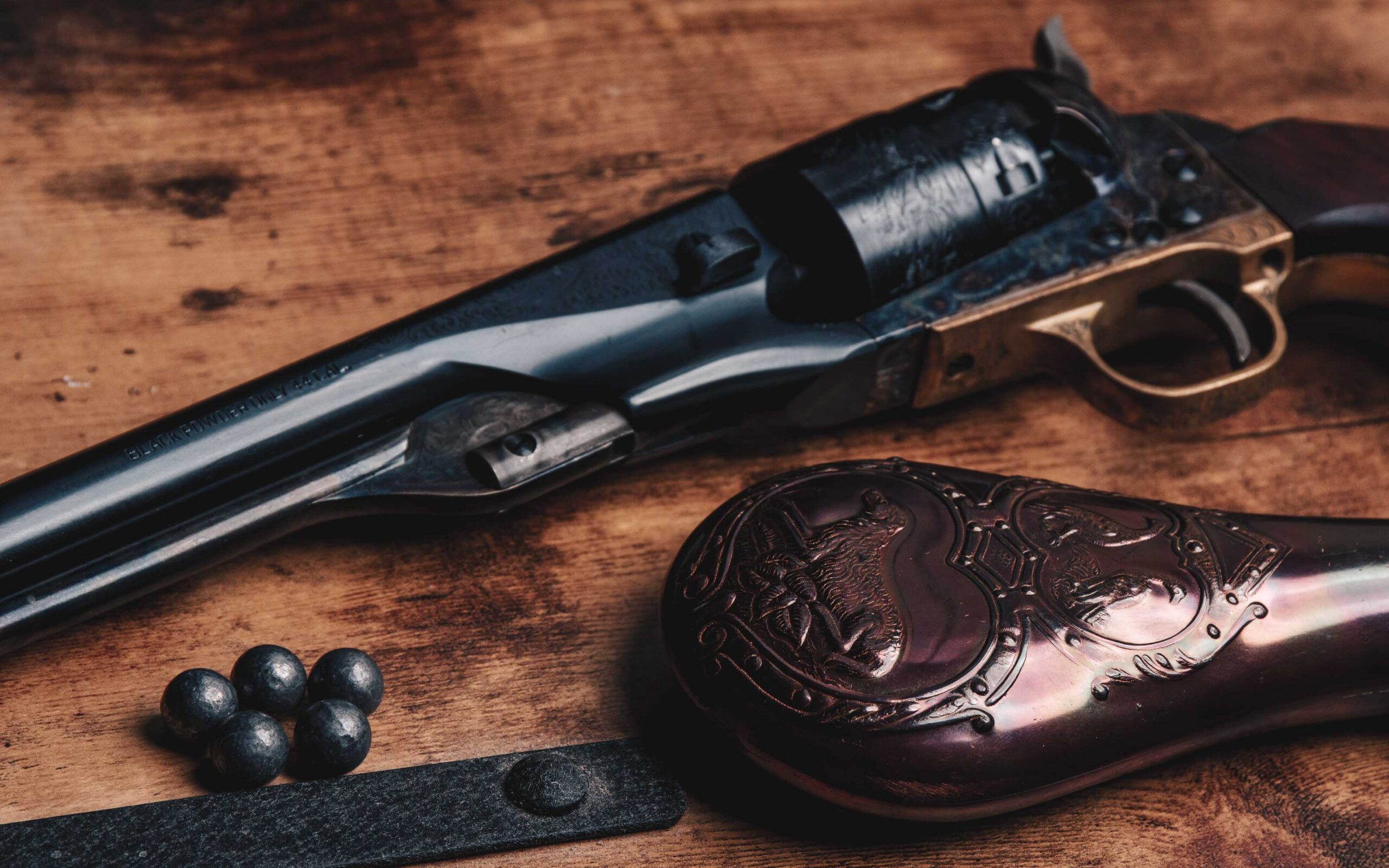
The 1851 Colt Navy became one of the most recognizable revolvers of the Civil War era.
The National Park Service describes it as probably the most-used handgun of the war. Colt produced more than 200,000 examples for Federal forces, while additional examples were captured and copied by Confederate manufacturers.
The National Park Service records the historical configuration as a .36 caliber percussion revolver with a six-round cylinder and a 7.5-inch barrel.
The Smithsonian also identifies the 1851 Navy as Colt’s most popular percussion revolver and documents its production from 1850 into the 1870s.
The “Navy” name can also cause confusion. The designation should not be interpreted as meaning every example was specifically issued to naval personnel.
For collectors, the important point is that the 1851 Colt Navy has identifiable historical characteristics that can be compared with a modern reproduction.
The 1860 Colt Army was another major percussion revolver of the Civil War period.
The National Park Service identifies it as at least the second most-used pistol of the war. It was a .44-caliber revolver and was especially associated with officers and cavalrymen. Colt sold nearly 130,000 examples to the United States during the conflict.
The 1860 Colt Army and 1851 Colt Navy are particularly useful for comparison because they can appear similar to someone unfamiliar with historical firearm models.
Their documented differences include caliber and design characteristics.
The National Park Service identifies the 1860 Colt Army as .44 caliber, while the 1851 Colt Navy was .36 caliber.
That illustrates an important lesson for replica collectors:
A firearm that looks similar to another historical design may still represent a different model.
The Griswold & Gunnison is one of the clearest examples of Confederate adaptation of an existing firearm design.
The National Park Service describes it as an almost direct copy of the Colt 1851 Navy. It was produced between 1862 and 1864 in Griswoldville, Georgia, and had a distinctive brass frame and round iron barrel.
The Smithsonian’s National Museum of American History identifies its example as a six-shot .36 caliber revolver made under contract to the Confederate government and describes it as a brass-framed copy of the Colt 1851 Navy.
This makes the Griswold & Gunnison especially valuable for understanding Confederate manufacturing.
It demonstrates that Confederate manufacturers did not always need to create an entirely new design. They could adapt an existing design while changing materials and construction details based on available resources.
For replica collectors, that means a Colt 1851 Navy reproduction and a Griswold & Gunnison reproduction should not be evaluated using exactly the same criteria.
The Confederacy entered the war with fewer industrial resources than the Union.
The National Park Service explains that much of the modern arms-making machinery and raw materials were concentrated in the industrialized North. Confederate manufacturers therefore had to combine domestic production, imported arms, captured Federal weapons, and machinery recovered from Federal facilities.
The Richmond Armory provides an important example.
Machinery from Harper’s Ferry was moved to Richmond after Virginia’s secession. Richmond then produced rifle muskets closely based on Federal patterns. The National Park Service estimates that approximately 107,000 shoulder arms were manufactured throughout the Confederacy by the end of the war.
The Smithsonian also documents a Richmond Armory musket made in 1863 and explains that Virginia seized the Harper’s Ferry machinery used to produce earlier U.S. rifle muskets.
This history helps explain why Confederate replicas can be especially interesting to collectors.
The differences are not merely cosmetic. They reflect the industrial conditions under which the firearms were produced.
The British Pattern 1853 Enfield is one of the most important imported firearms associated with the Civil War.
The National Park Service identifies it as the most-used shoulder weapon by Confederate soldiers and states that approximately 900,000 Enfields were imported, mostly by the Confederacy.
The Smithsonian identifies its Pattern 1853 example as a .577 caliber rifled, muzzle-loading percussion rifle musket made in 1862.
The Enfield is important because it demonstrates that Civil War firearm history cannot be understood entirely through American-made weapons.
International manufacturing and wartime imports played a major role in supplying the armies.
For collectors, an Enfield replica can therefore represent both Civil War military technology and the international arms trade that supported the conflict.
The Civil War occurred during a transition between older muzzle-loading systems and newer breechloading and repeating firearms.
The standard infantry weapon remained the muzzle-loading .58 caliber rifle musket. The National Park Service explains that this loading system limited efficiency compared with later breechloading designs.
At the same time, newer technologies were already appearing.
Breechloading firearms allowed ammunition to be loaded through the rear of the barrel rather than through the muzzle. Repeating designs went further by allowing multiple shots before reloading.
The National Park Service’s Springfield Armory collection includes examples associated with this technological transition, while Smithsonian collections document Civil War-era repeating and breechloading designs.
This makes Civil War firearm collecting particularly interesting because the period sits between different generations of military technology.
A collection can therefore tell a technological story rather than represent one historical year alone.
Comparing Civil War gun replicas can reveal more than differences in appearance. When replicas are tied to specific historical models, they can be used to study changes in manufacturing, military supply, international trade, and firearm technology during the 1860s.
A useful way to compare replicas is to ask the same five historical questions about each design.
Manufacturing location can reveal the economic and industrial conditions behind a firearm.
An M1861 Springfield connects the collector to Federal manufacturing and standardized production. A Richmond rifle musket provides a different perspective on Confederate manufacturing. A Pattern 1853 Enfield introduces the international production and importation of arms during the war.
The military role helps explain why one design was important even when another firearm looked similar.
Infantry shoulder arms served a different purpose from revolvers associated with cavalrymen and officers. Imported firearms also occupied a different place in the wartime supply system than domestically manufactured weapons.
A firearm’s design can be understood more clearly when viewed as a response to a particular military or manufacturing requirement.
The widespread use of muzzle-loading rifle muskets reflects the technology available for mass infantry production at the time. At the same time, breechloading and repeating designs demonstrate that firearm technology was already moving toward faster-loading systems.
Materials and construction can provide clues about manufacturing conditions.
The Griswold & Gunnison is particularly useful because its relationship to the Colt 1851 Navy shows how an existing design could be adapted for Confederate production. Its documented brass frame and round iron barrel are not simply visual details. They are evidence of a particular manufacturing history.
Civil War firearms also provide a way to study technological transition.
The conflict took place during a period when older muzzle-loading systems existed alongside newer breechloading and repeating designs. Looking at these firearms together helps explain why military technology did not change from one system to another overnight.
For collectors, this creates a useful way to organize a historical collection. Instead of asking only, “Which replica looks most interesting?” a collector can ask, “What historical development does this replica help explain?”
That approach can turn a collection into a visual timeline of American manufacturing, wartime supply, and changing firearm technology.
Historical accuracy is more complicated than making a reproduction look old. A historically accurate Civil War gun replica should correspond to a specific firearm, production period, and manufacturing tradition rather than simply having a 19th-century appearance.
Collectors can evaluate accuracy by comparing the reproduction with documented examples from museums, historical collections, and primary-source photographs. The goal is not to determine whether every modern component is identical to an original artifact. Instead, the goal is to determine whether the replica faithfully represents the historical design it claims to reproduce.
Start with the exact model name. “Civil War revolver” is too broad to establish historical accuracy, while a designation such as “1851 Colt Navy” identifies a specific historical reference point.
This distinction matters because several Civil War-era firearms shared similar overall shapes while differing in caliber, materials, markings, manufacturing history, and intended use.
Overall proportions are among the easiest characteristics to compare visually. Examine the relationship between the barrel, frame, grip, stock, cylinder, and other major components.
A reproduction does not need to be an exact copy of one surviving artifact to be historically representative. However, significant differences in proportions can indicate that it represents a different model or a simplified interpretation.
Materials can provide important clues about the design being reproduced.
The Griswold & Gunnison is a useful example. Its brass frame and round iron barrel are documented characteristics that distinguish it from the Colt 1851 Navy it closely copied. That difference is historically meaningful because it reflects the manufacturing conditions and available resources of Confederate production.
For collectors, material choices can therefore provide information about both the firearm and the industrial environment in which it was produced.
Markings can help distinguish one historical firearm from another. Manufacturer names, armory markings, inspection marks, serial numbers, and other identifying details may provide useful evidence when comparing a reproduction with documented examples.
However, collectors should avoid assuming that every original firearm carried exactly the same markings. Production location, manufacturing period, contractor, and surviving examples can all affect what appears on an individual firearm.
Historical firearm designs were not always completely static. A model could undergo changes during its production history, and different manufacturers could produce variations of a related design.
This is particularly important when evaluating replicas of firearms that existed before and during the Civil War. A reproduction may accurately represent a historical design while still differing from another version of the same general model.
Researching the production period therefore provides context that appearance alone cannot provide.
Historical use adds another layer of accuracy.
Ask whether the original design was primarily associated with infantry, cavalry, officers, civilian ownership, Union forces, Confederate forces, or imported military supply. The answer can help explain why the firearm mattered during the Civil War and whether the reproduction fits the historical context being represented.
For example, an M1861 Springfield reproduction represents a standardized Federal infantry arm, while a Pattern 1853 Enfield reproduction can represent the international arms trade that supplied Civil War armies.
The strongest way to evaluate a reproduction is to compare it with multiple documented sources.
Museum collections can establish physical characteristics. Historical photographs can provide visual context. Institutional records can help establish production dates and military use. Comparing several sources is especially useful when surviving examples vary.
A useful accuracy checklist is:
This approach provides more useful information than judging a replica solely by whether it “looks old.” It also helps collectors understand why two replicas from the same general period can represent very different historical stories.
The most reliable way to research a Civil War gun replica is to work from the specific historical model to documented evidence. Instead of starting with a modern product description, identify the original firearm first and then compare the reproduction with museum records, historical photographs, and institutional collections.
Start with the model designation rather than a broad category.
For example, “Civil War revolver” could refer to several different designs. Identifying the 1851 Colt Navy, 1860 Colt Army, or Griswold & Gunnison immediately gives the research a specific historical reference point.
Find out who manufactured the original and when it was produced.
Production dates can help explain differences between examples of the same general design. They can also reveal whether a firearm was produced by a Federal armory, Confederate manufacturer, private company, or foreign manufacturer.
Museum collections are valuable because they provide documented examples rather than relying entirely on modern interpretations.
The National Park Service documents several major Civil War firearms, including the M1861 Springfield, 1851 Colt Navy, 1860 Colt Army, Griswold & Gunnison, and Pattern 1853 Enfield. The Smithsonian also maintains documented examples of Civil War firearms and related military equipment.
These collections can help establish characteristics such as materials, caliber, configuration, production history, and historical use.
Photographs can provide information that written specifications do not always communicate clearly.
Civil War-era photographs can help researchers understand how firearms appeared in period settings and how they were associated with soldiers and military equipment. The Library of Congress is particularly useful for historical photographs and primary-source material.
Photographs should still be interpreted carefully because image quality, perspective, and identification can affect what can be determined from an individual photograph.
One source rarely answers every historical question.
A museum record may provide physical specifications. A historical photograph may provide visual context. An institutional history may explain manufacturing or military use.
Comparing these sources allows collectors to distinguish documented characteristics from assumptions.
Modern product descriptions can explain what a replica is intended to represent, but they should not automatically be treated as historical evidence.
For historical research, prioritize documentation from established museums, government institutions, libraries, and recognized historical collections. Then use the modern product description to determine how closely the replica corresponds to that historical reference.
A simple research record can make future collecting easier. For each replica, record:
This turns a replica collection into a documented historical study rather than a group of objects identified only by appearance.
The key principle is simple: identify the original firearm first, then evaluate the reproduction against multiple independent historical sources. That method provides a stronger basis for understanding accuracy, historical context, and design differences.
A comparison can make the major designs easier to understand:
Historical design | Main type | Distinguishing historical point |
|---|---|---|
M1861 Springfield | Rifle musket | Standardized Federal infantry arm |
Pattern 1853 Enfield | Rifle musket | Major British import used heavily by Confederate forces |
1851 Colt Navy | Revolver | .36 caliber, six-shot percussion revolver |
1860 Colt Army | Revolver | .44 caliber military revolver |
Griswold & Gunnison | Revolver | Confederate copy of the Colt 1851 Navy |
Richmond rifle musket | Rifle musket | Confederate manufacture based on Federal patterns |
Henry Rifle | Repeating rifle | Early repeating design representing technological change |
This comparison is useful because it shows that “Civil War firearm” is not one category with one design.
Each model represents a different combination of manufacturing history, military purpose, technology, and wartime supply.
Original Civil War firearms are historical artifacts. Their importance can depend on condition, provenance, rarity, markings, documented ownership, and historical association.
A non-firing replica serves a different purpose.
A well-researched, museum-quality replica can allow collectors to study the appearance and design of a historical firearm without acquiring an original artifact.
The National Park Service specifically discusses reproduction arms as an option for enthusiasts who want to engage with historical firearm designs without putting valuable historic examples at risk through use.
For collectors, this can make replicas useful for:
The value of the replica comes from the historical information attached to it.
The strongest collections usually have a clear theme.
Instead of collecting unrelated replicas, choose a historical question.
Focus on Federal infantry arms such as the M1861 Springfield and related designs.
Focus on Richmond, Fayetteville, and Confederate-produced firearm designs.
Compare the 1851 Colt Navy, 1860 Colt Army, Griswold & Gunnison, and other period revolvers.
Focus on designs such as the British Pattern 1853 Enfield.
Show the transition from muzzle-loading firearms toward breechloading and repeating systems.
A themed collection makes it easier to explain why each replica belongs in the display.
Use a research checklist rather than evaluating appearance alone.
Question | Why it matters |
|---|---|
What exact firearm does it represent? | Establishes the historical reference |
Who manufactured the original? | Helps identify authentic characteristics |
When was it produced? | Establishes the historical period |
Who used it? | Adds military and historical context |
Was it Union, Confederate, or imported? | Helps establish its historical significance |
What materials characterized the original? | Helps evaluate the reproduction |
Are the proportions consistent? | Supports visual accuracy |
Are markings represented appropriately? | Helps distinguish models |
Is the reproduction non-firing? | Important for its intended purpose |
Where will it be displayed or used? | Local requirements can vary |
This approach produces a more informed collection and helps prevent similar historical designs from being incorrectly grouped together.
A historical display works best when the replica is accompanied by information explaining what it represents.
Consider including:
For example, a Griswold & Gunnison reproduction becomes much more informative when accompanied by a description explaining its relationship to the Colt 1851 Navy and its connection to Confederate manufacturing.
Secure display furniture and appropriate mounts can also help reduce unnecessary handling. Keep replicas protected from excessive moisture, direct sunlight, dust, and accidental damage.
For additional visual inspiration, you can link readers to the Trigger Replicas Gallery.
They can, provided they support the same historical theme.
A Civil War display might include replica swords, military accessories, maps, photographs, documents, uniforms, or other period-inspired objects.
For example, a collection focused on Union infantry could incorporate supporting military artifacts that help explain the soldier’s equipment and daily experience.
A Confederate manufacturing display could instead emphasize Southern production, supply challenges, and examples of adapted designs.
The goal should be historical consistency rather than adding more objects.
Non-firing replicas are designed as reproductions rather than functioning firearms, but realistic replicas should still be handled responsibly because they can be mistaken for real firearms.
Requirements can also vary depending on location and intended use. Collectors should verify applicable rules before purchasing, shipping, transporting, displaying, or bringing a realistic replica to a public event.
Private display, reenactment, conventions, photography, theater, and other settings may involve different requirements.
Trigger Replicas states that its products are non-firing replicas and that customers are responsible for confirming that merchandise is legal to purchase and own in their jurisdiction.
For additional information, readers can review the site’s Uses for Non-Firing Replica Guns guide.
A replica can become a starting point for much broader historical research.
For any particular design, ask:
These questions turn a replica into a historical research tool.
For example, studying the Griswold & Gunnison can lead to research into Confederate industrial capacity. Studying the M1861 Springfield can lead to research into standardization and mass production. Studying the Enfield can reveal how international arms imports affected the war.
That is where replica collecting becomes particularly valuable for history enthusiasts.
Manufacturing capacity was one of the major factors behind the differences between Northern and Southern firearm production.
The National Park Service explains that the United States entered the war with significant advantages in firearms manufacturing, mass production, standardization, machinery, and raw materials. Much of the modern arms-making equipment was concentrated in the industrial North.
The Confederacy responded by combining domestic production with imports, captured arms, and machinery taken from Federal facilities.
The Richmond Armory is a particularly useful example because its production was closely connected to machinery and expertise transferred from Harper’s Ferry.
This gives historical replicas an additional layer of meaning.
A Richmond rifle replica can represent not only a firearm design but also the industrial circumstances in which Confederate manufacturers attempted to supply an army.
For historical research, start with institutions that maintain documented collections.
The National Park Service provides detailed information about Civil War weapons, including the M1861 Springfield, 1851 Colt Navy, 1860 Colt Army, Griswold & Gunnison, and Pattern 1853 Enfield.
The Smithsonian maintains records for Civil War firearms, including the Pattern 1853 Enfield, Richmond Armory musket, and Griswold & Gunnison.
The Library of Congress also provides historical photographs and primary-source material showing Civil War soldiers and their equipment.
Using these resources gives collectors a stronger basis for evaluating a replica than relying only on modern descriptions.
The most important point is that there is no single “Civil War gun.”
The period included standardized Federal rifle muskets, imported Enfields, percussion revolvers, Confederate copies, Southern-produced firearms, captured weapons, and early examples of breechloading and repeating technology.
That diversity is what makes Civil War replica collecting interesting.
A collector who identifies the exact historical model, researches its manufacturer and production period, compares it with documented museum examples, and understands its Union, Confederate, or international context can get far more historical value from the reproduction.
A Civil War gun replica is a modern reproduction representing a firearm associated with the American Civil War from 1861 to 1865. Non-firing examples are commonly intended for collecting, display, education, reenactment, and historical interpretation.
Commonly reproduced designs include the 1851 Colt Navy, 1860 Colt Army, M1861 Springfield, Pattern 1853 Enfield, Richmond rifle, and Griswold & Gunnison.
There is no single answer because different firearms served different purposes. The National Park Service identifies the M1861 Springfield as the most popular infantry shoulder arm and the 1851 Colt Navy as probably the most-used handgun.
The reproduction should correspond closely to the specific historical model it represents. Collectors can compare proportions, materials, markings, construction characteristics, production period, and historical context with documented examples.
They can illustrate the manufacturing and supply challenges faced by the Confederacy. Designs such as the Griswold & Gunnison demonstrate how Southern manufacturers adapted established firearm designs.
A non-firing replica is designed as a reproduction rather than a functioning firearm. However, realistic replicas should still be handled responsibly, and collectors should verify applicable requirements before purchasing, transporting, or displaying them.
Civil War gun replicas can provide a physical connection to the technology, manufacturing, military supply, and industrial history of the 1860s.
The best way to approach a replica is to research the specific historical firearm behind it. A reproduction of an M1861 Springfield tells a different story from a Pattern 1853 Enfield, 1851 Colt Navy, 1860 Colt Army, or Griswold & Gunnison.
By comparing modern reproductions with documented examples from the National Park Service, Smithsonian, Library of Congress, and other historical collections, collectors can understand not only what these firearms looked like, but why their designs mattered.
Explore the Trigger Replicas Shop to see historical non-firing replicas and build a collection around the designs and stories that interest you most.